

Chia Amisola is Bringing Karaoke and Pisonets to Art Fair 2025
'Kakakompyuter Mo Yan' is no longer just a meme, it's art that wants to bring intimacy back to the internet.
(SPOT.ph) Whether within the concrete walls of The Link carpark or out in the gardens of Ayala Triangle (as it will be this year), Art Fair Philippines is a host to familiar sights every year: paintings and sculptures on display, big-name artists casually sitting by their works or giving talks, visitors snapping their next profile pic in front of an “estetik” opus-turned-background, and at least one person sipping a glass of wine before noon.
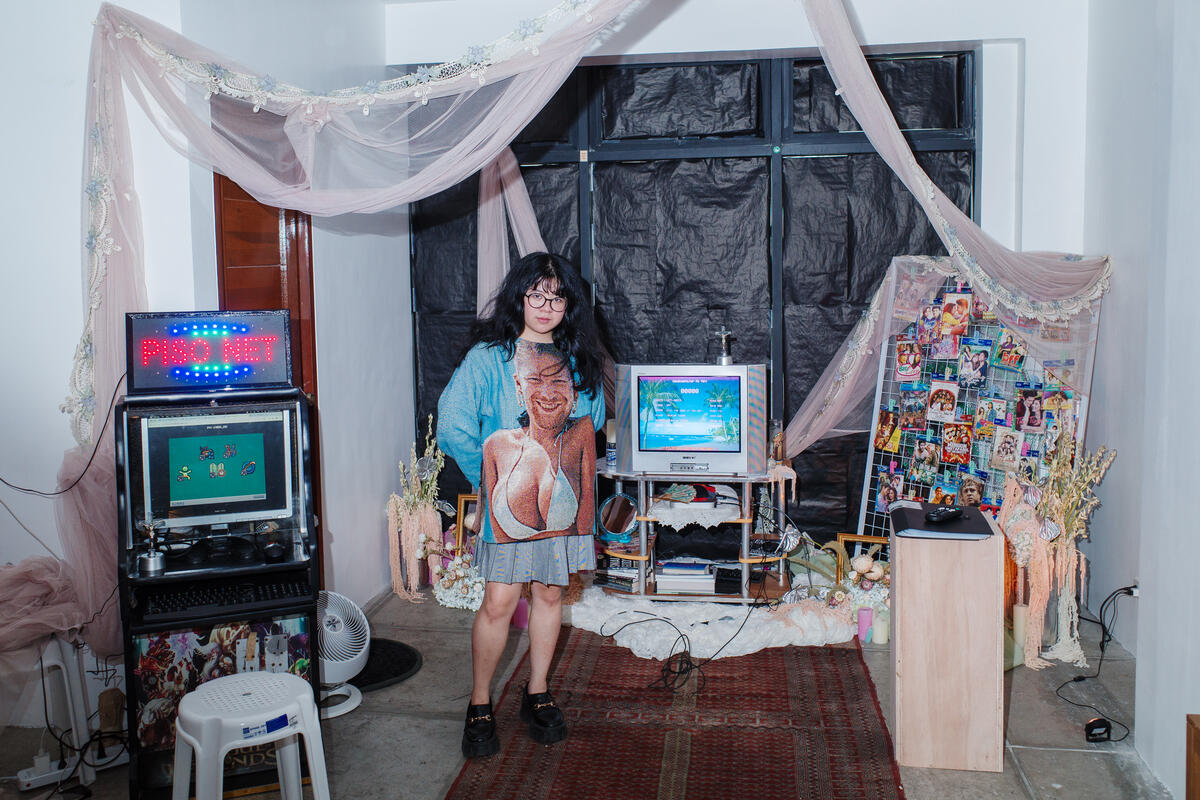
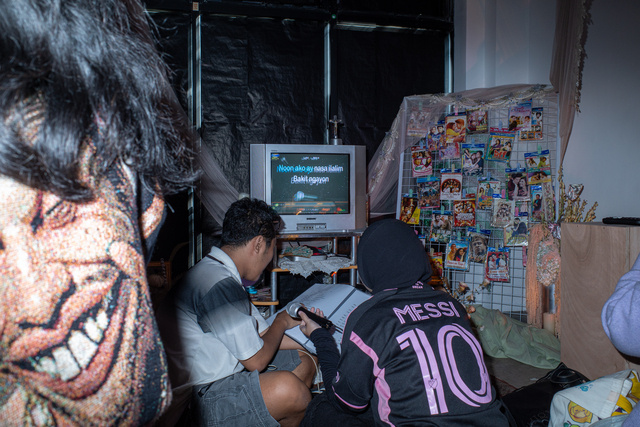
At this year’s Art Fair, however, you might hear something different as you're hitting up the galleries: singing. Most likely off-key. Follow the noise, and you’ll find a queue—not for tickets, but to use a karaoke machine, as well as pisonet terminals situated in what looks like an average Filipino family living room.
Welcome to Kakakompyuter Mo Yan, a “neverending karaoke party” of internet art by over 20 different artists, all exploring the Philippines’ relationship with internet and networking culture. All of the show’s featured works are app- and browser-based, and none of them can be purchased, making for a unique, almost antithetical inclusion in Art Fair—a veritable marketplace for art—as they challenge traditional art and conventional narratives.
Take for example: Agu Crisostomo’s “Alt-Tab,” a game exploring budding queer identity, or Beatris Cabaña's “To Induce a Period,” which simulates the experience of buying an abortion online and reveals the hidden networks of support in women’s forums. On the other end of the spectrum, Mac Andre Arboleda’s “I-LOVE-YOU.PH” is a digital shrine to infamous ILOVEYOU virus creator Onel de Guzman, while Jared Jonathan Luna’s “Jared vs TikTok” features the artist’s dance battle against the TikTok algorithm.
Also read: Guide to Art Fair Philippines 2025: Everything You Need to Know

Chia Amisola explains Kakakompyuter Mo Yan
“These are counter-narratives about what it means to make art about the internet, as people who have been uniquely exploited and shaped by it,” says show curator Chia Amisola, who actually double-hatted as artist collaborator and developer for many of the pieces on Kakakompyuter Mo Yan.
“The internet that we think about today looks very different from the internet that we grew up with,” they continue. “Technology today is a lot more isolating. People don’t feel as agendic, like they don’t have control anymore over their attention, their time. There are less places that you can really share with friends because everything’s just trying to compete for your attention. So in my work, I try to make websites, games, and any online-based work that tries to imagine a more intimate internet again.”
Internet art is a brave new world on the scene, a can of worms that questions what counts as art and who can be an artist. Growing up in the age of Neopets and Pokemon fansites, Amisola would learn how to code HTML and CSS at the age of seven to create fansites and later explore graphic design—but would still view illustrator friends at school as more artistic. They pursued Computer Science and the Arts at Yale on scholarship, but found that digital media wasn’t fully grasped even there. However, it was during their studies that Amisola would realize that their interest in the computer could actually be seen in a more artistic way.
“It’s performance art: if you can construct a website, you can construct something that feels like an architectural space or sculptural artifact,” they say. The latter becomes more apparent with context, with the Philippines’ relationship with the internet being different from the West’s.
Also read: 10 Days of Art Will Bring You on an Art Walk Around Makati City
Bringing intimacy back to the internet experience
Beyond their day job as product designer at UI design tool Figma, Amisola has turned their attention to using technology more artistically and culturally. In 2016, they founded Developh, a community building identity and space for third world internet. Developh gives talks and workshops on programming and design, and works to preserve Filipino internet, culture, and media through the Philippine Internet Archive and the Martial Law Index.
Kakakompyuter Mo Yan is unique among Amisola and Developh’s projects in the fact that it simultaneously occupies both the digital realm (all pieces are all available to view online forever) and this special offline exhibition, which makes them accessible pisonet terminals and a home karaoke machine, which aside from launching different pieces, can be used to actually sing songs by Ne-Yo, Chapell Roan, Laufey, and more.
“There are still ways to present technology in a way that inherently calls for community, in contrast to a phone,” explains Amisola. “Karaoke demands a shared space. There are so many tensions—who’s performing? Are they doing well? Did you select something that everyone else wants?”
Meanwhile, the pisonet terminals allow you a more immersive experience, especially with heavily-interactive works such as Anton Romero’s “Peer to Peer,” a filesharing client ala Limewire where each downloaded torrent reveals intimate reflections on piracy and nostalgia. But the limited number of terminals will inevitably cause lines to form, with strangers waiting their turn and looking at your screen over your shoulder.
And the experience will always change with context—and the exhibit’s iterations in London, Hong Kong, New York, San Francisco have all seen distinct and differing behaviors and energies with a simple change in location.
Amisola says, “I want all these little social dynamics and cues to be at the top of your head. Sure, internet art can be private and experienced alone, but you can never extract it from how distributed and communal the internet is. You’re in a shared space, and technology should make us more hyper aware of how we are in relation to other people.”
Kakakompyuter Mo Yan is an exhibit you could immerse yourself in for hours, but the true experience lies in the actual, active experiencing of these digital works in a communal space. There is, after all, no rush to absorb every single piece when they’re all available for your viewing pleasure online at home. To fully appreciate the show, being present is critical.
“The space is designed to help you reconsider your relationship with technology,” says Amisola. “How are our screens different in public spaces versus the privacy of our homes? What does it mean to share technology with people—and how do we make it open and fun again?”
--
Kakakompyuter Mo Yan! will be exhibited offline at Art Fair 2025 from February 21 to 23 at Ayala Triangle. For tickets and more information, visit the official Art Fair website.