
(SPOT.ph) They’re the rising stars of the Philippine art world, pushing the boundaries of contemporary art making, changing our perceptions of what is “serious art”, and basically just making us reconsider the way we view worlds in and outside of the canvas.
If you’re a young collector, this is a good article to bookmark. If you’re just someone who likes to follow local art and are interested in knowing who’s who, this is a good place to start. Consider this list a snapshot of what’s happening out there in the year 2025—the themes being explored, the doors being flung open, the styles previously scoffed at and now being accorded respect.
It's a pretty credible list, too, if we may say so ourselves—not only because we’re totally convinced each of these talents have something to say, but because we also sought the expertise of a few insiders to put this list together: an art scene mover and shaker, three influential gallerists, and one very active collector.
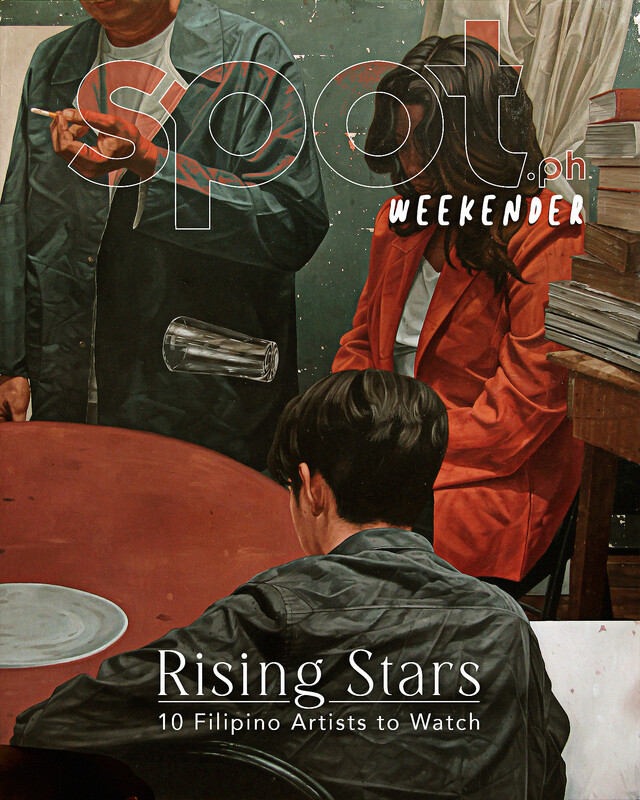
Some of these artists shone brightly recently at the just concluded Art Basel Hong Kong, repping Filipino talent in one of the most prestigious art venues in the world. Some are preparing for a big show this year. And one is about to take the stage at an art museum in Shanghai as you read this, ready to command a room, maybe even transform an audience.
Meet Spot’s 10 Filipino artists to watch. To borrow the words of one of our insiders, they’re intelligent, confident, and have found their voices early on. Of course, he only said that about the names on his list, but we're convinced it applies to each and every name below.
Meet Spot's 10 Filipino artists to watch
Jomari T’leon
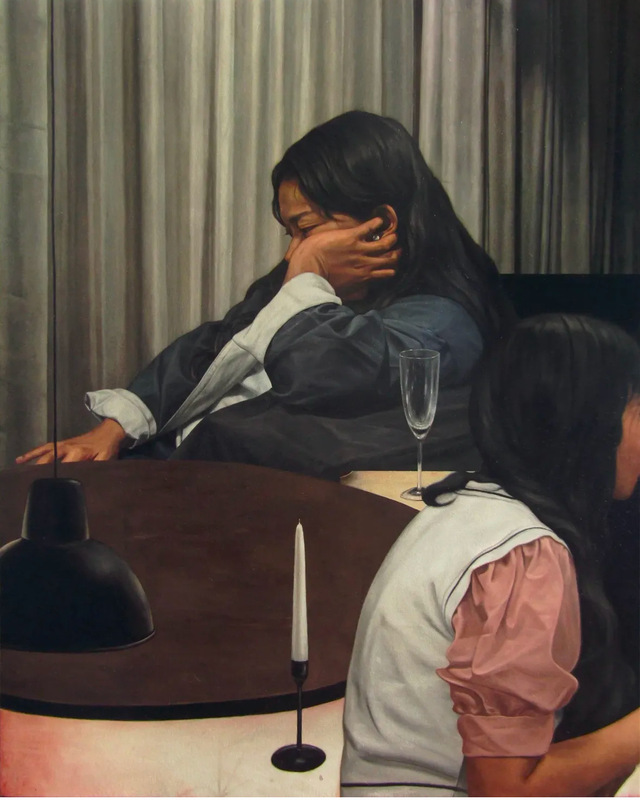
The characters in his paintings almost never show their faces—as if witnesses or forced participants to shady activities, preferring to turn their heads the other way or remain in the fringes. Which should be the total opposite of how artist Jomari T’Leon should be carrying on in life, having made quite a career for himself at only 27, producing work possessed with the weight and self-assuredness of someone way beyond his years—and to think he burst into the art scene only during the pandemic.
Perhaps because he’s been at it ever since he can remember. “Art came to me very early on, even when I didn’t have any idea yet what ‘art’ really meant,” the TUP Manila Fine Arts grad tells Spot. “I’ve been drawing or making ‘art projects’ since I was a kid just because I wanted to. It’s an impulse. There's no one point in my life when I realized I like making art; it was always there.”
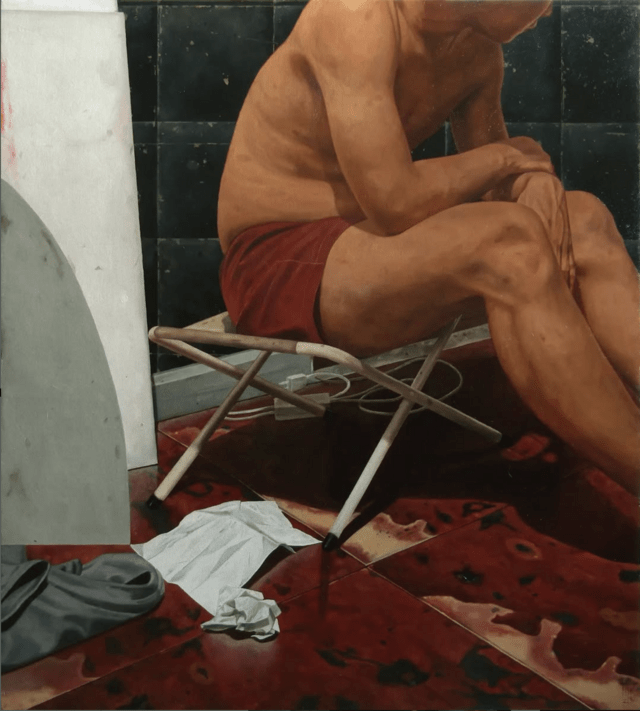
Jomari has staged two more solo shows ever since his inaugural one at Blanc, the QC gallery known for discovering the next exciting art talent. Just this weekend, Jomari closed a show at Finale Art File called Snake Infested Temple, a sort of continuation of his West Gallery exhibit, his third solo. If in the latter he explored the idea of departing a place that no longer thrives, in this recent show he paints about what’s stopping us from leaving our personal dead ends—even when we’re clearly risking our very existences.
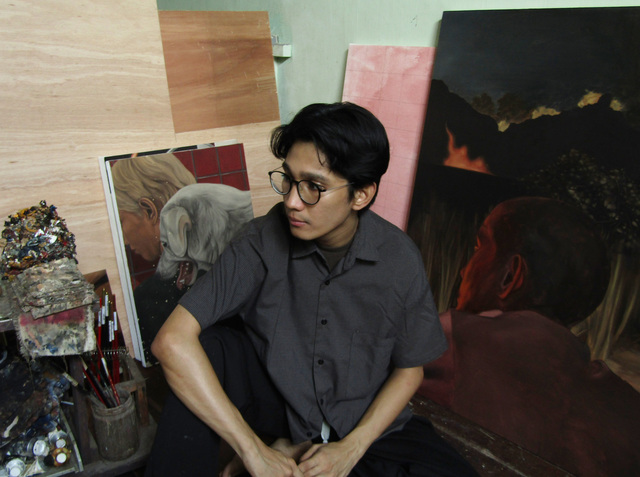
In contrast, Jomari's career is only moving forward. Next up for the artist is another solo at Blanc November this year—which should give his fans something to look forward to. How does an artist like him define success? “As long as I could continue the practice of artmaking, I’d consider myself successful.”
Isha Naguiat
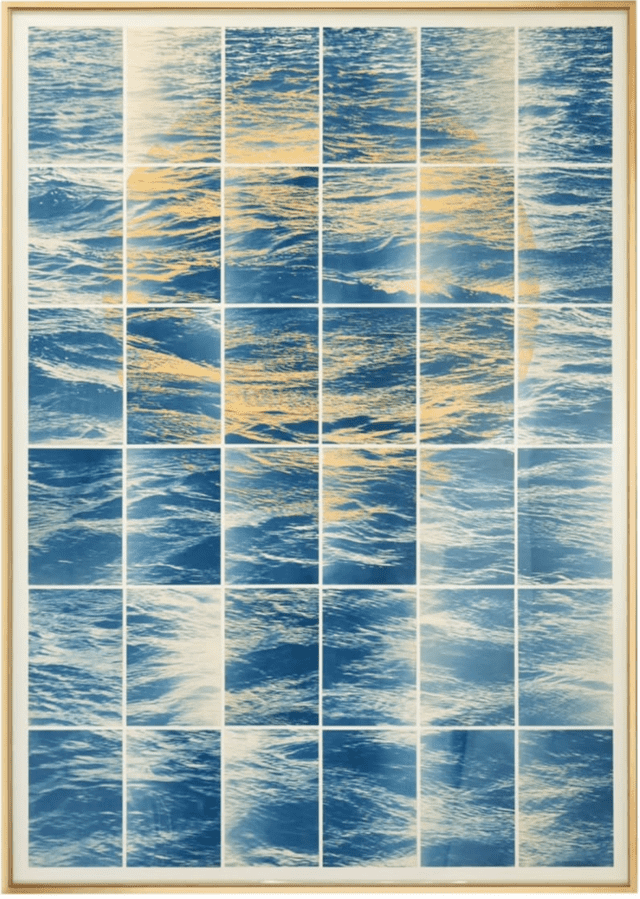
Isha Naguiat is known for her works that combine cyanotype photography and embroidery on paper. The first time we saw one, in a Solaire North hallway of all places, it was like seeing an apparition—kind of mesmerizing from afar and has that calming effect up close.
“It was the largest-scale work I had ever created,” Isha tells Spot of the piece, a sort of patchwork of a sea of waves. “Each section was individually printed and embroidered, then assembled into a larger composition.” She approached it one frame at a time. “I wanted viewers to experience the vastness of the piece as a whole but also notice the intricacies within—how the smaller elements come together to create something much bigger.
“That idea of shifting between micro and macro perspectives was not just for the audience but also a reminder to myself: to be immersed in the details, but to always step back and see the bigger picture.”
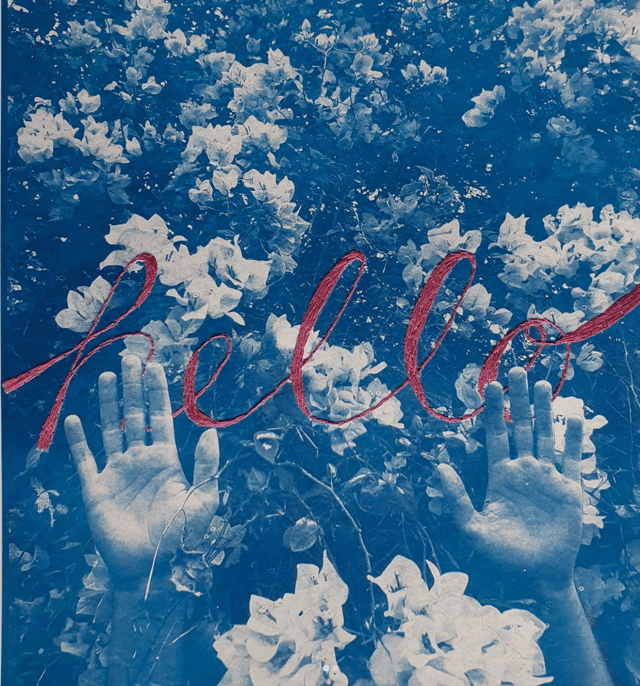
Isha started playing around with cyanotype during the pandemic while researching on alternative photography. “What drew me in was the immediacy of the process,” she says, “watching an image develop under the sun felt almost magical. Even the imperfections had a beauty of their own.” The addition of embroidery came naturally — stitching has long been part of her art practice, and surprisingly fit right in with the crafty character of cyanotype images. “I realized my cyanotype prints always felt like they needed something more. The deep blues were striking but also felt monotonous at times, and embroidery allowed me to break that uniformity.“
The UP Fine Arts grad has always considered herself an “art girl,” drawing and coloring for as long as she can remember. She considered taking on a different path— once taking on the job of gallery assistant—but it was clear her place was in front of a canvas. She loved being surrounded by art but like some of her pre-embroidery cyanotype works, something always felt missing. “Eventually, I realized that no matter where I ended up, I kept coming back to making. That’s when I knew [art] wasn’t just something I liked doing—it was something I needed to do.”
Chelsea Theodossis
The first ever painting that caught Chelsea Theodossis’ fascination was that of three kittens. “I would often stare at it wondering how is it possible that the painter was able to paint every strand of the fur. That idea was insane for me back then.” This was when Chelsea was still a child spending time with her grandmother in Nueva Ecija, free to mine the treasure trove that was her lola’s stash of single-use items tidied up for later use.
These days, however, Chelsea mines her personal memories, and paints insanely beautiful, almost otherworldly images, distinct from the purr-fectly realistic art (sorry, we can't help it) that first caught her fancy. It is these works that have won her the admiration of art-watchers and gave the young painter opportunities to share her art to a greater public.
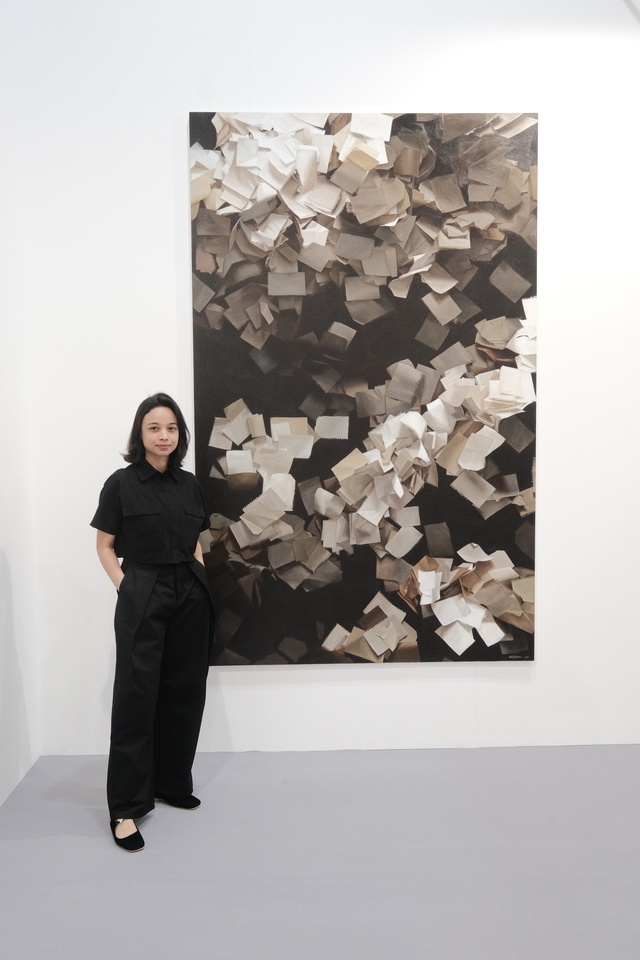
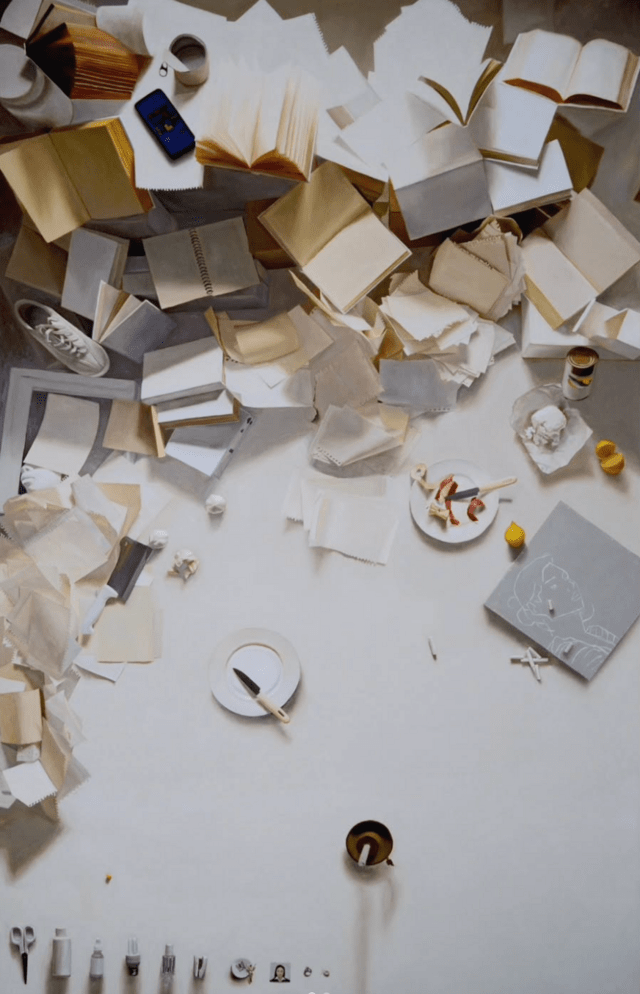
Chelsea paints explosions of books and blank pages in rooms bathed in heavenly light. One write-up says they’re about those who’ve left the world before us, whose stories could have filled those pages; another quotes Chelsea herself saying they're attached to many different personal memories. Is it important to her what message audiences choose to take?
“The memories attached to blank pages are the root and birth of the concept while the context of death was my reality at the time of making. This is a common debate that I particularly like to be fluid about. I recognize that sharing my reasons for making the works deepens the understanding of the viewer but I also like the idea that the moment I share it to the public its interpretation immediately becomes open-ended. My message isn't lost but it is up for evolution beyond my intention—a chance to see the works through other's eyes.”
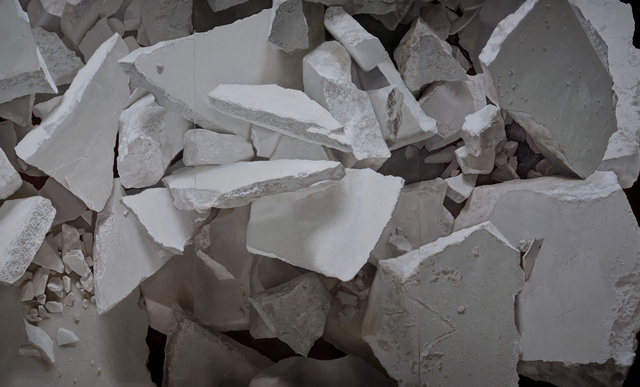
And speaking of evolutions as occurrences not in our control, time has made this artist realize the world demands differently of the child artist Chelsea from the grownup artist Chelsea—although she clearly sounds grateful the “artist” part has been a constant.
“As a child, art making is innate but as I grew up I had to do plenty of things that are not about following curiosities but mainly for survival and fulfilling responsibilities. That's when I realized I'm often waiting for ‘art time.’ In school, I wait for the time where teacher would ask us to bring out our crayons. In college, I spend more time drawing leaves, skeletons, microscopes and muscles than reading their purpose or the process of photosynthesis. At work, I wait for events that require prop making and the like. I noticed art making is something I'm willing to do even if it's long and painstaking.”
TRNZ
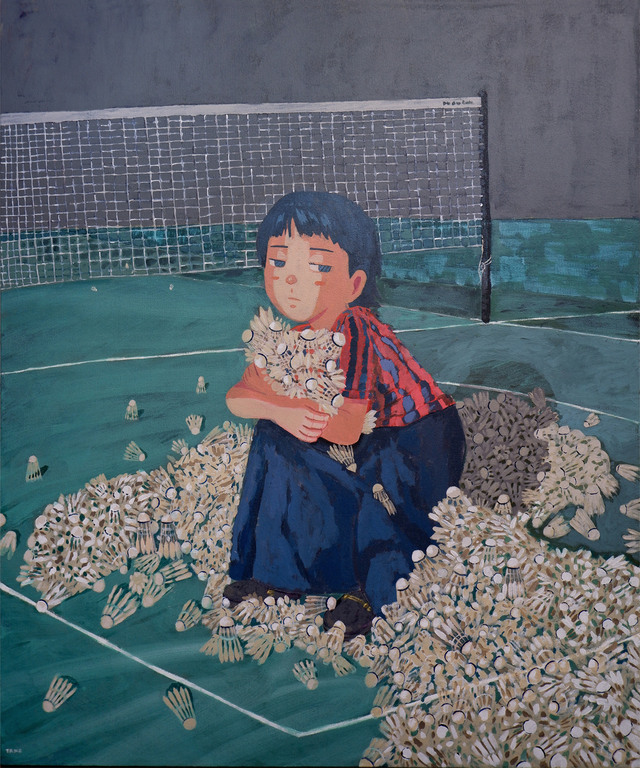
If you stopped by Art in the Park last March 23, you may have come across one of their special exhibits by TRNZ (aka Terence Eduarte).
His pieces often depict children engaged in everyday activities—standing in the rain, combing their hair, sitting on a stool. While they may appear simple and innocent at first glance, a closer look reveals a deeper exploration of what TRNZ describes as “misarrangement, repetition, and subtle anomalies"—hallmarks of his distinctive and artistic language.
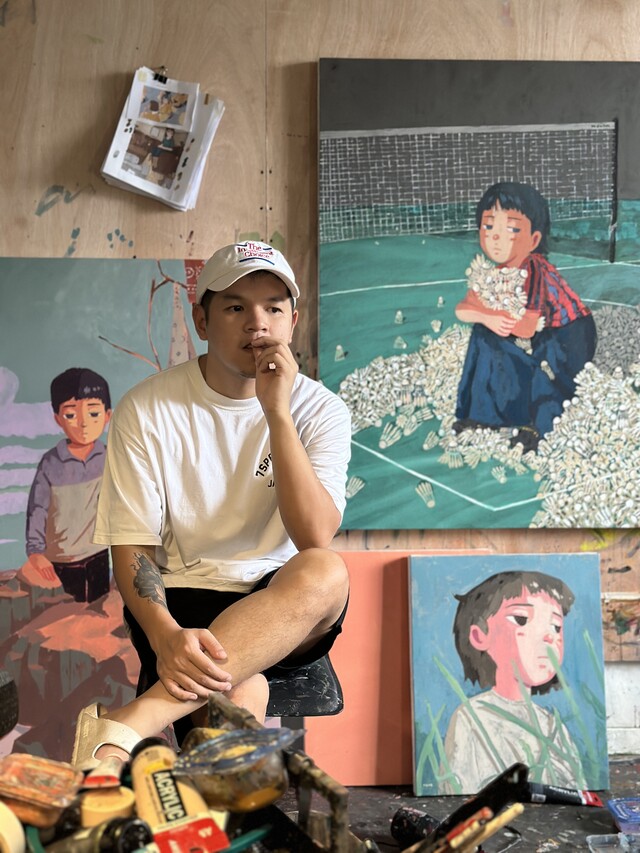
Growing up in Project 4, Quezon City, TRNZ developed a strong connection to his environment, which continues to shape his work. "The textures, colors, and objects that surround me have become central to my artistic language," he explains. "I continue to explore these elements or objects in my work, seeing how they evolve and shift in meaning whenever I exaggerate, multiply or put them in places where they are not meant to be.”
His artistic journey began in an unexpected place–Tagalog-dubbed anime. Without any access to cable TV in the 90s, TRNZ found inspiration in classics like Dragon Ball Z and Ghost Fighter (Yu Yu Hakusho). “It was my gateway to artmaking,” he recalls, “...I literally learned how to draw Goku first before I even learned how to draw proper anatomy.”
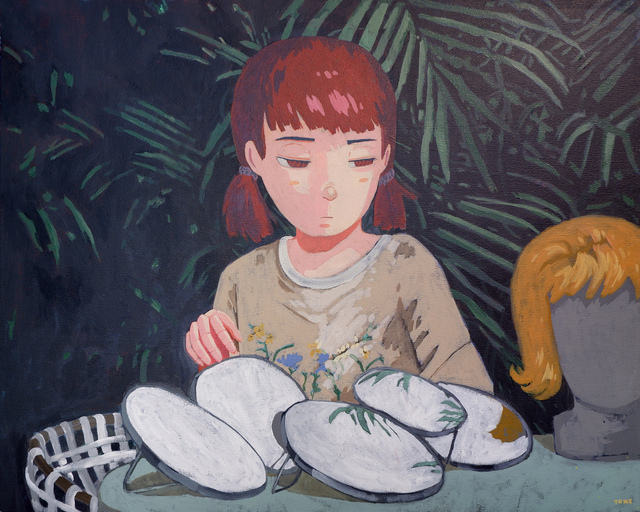
TRNZ has exhibited widely, from local galleries such as Vinyl on Vinyl and Blanc to international showcases in Los Angeles, Korea, and Paris. In 2023, his solo show The Weight of Things at Thinkspace Projects in Los Angeles explored the idea of burdens—both physical and emotional. His subjects carried or balanced objects like a balloon crown, a walis ting-ting, or tangled extension cords. “The artist from the Philippines uses ‘The Weight of Things’ to navigate the same process with an exceedingly charged relationship between the figures and the objects surrounding them,” the gallery notes explain.
That same year, TRNZ was Vinyl on Vinyl’s sole exhibitor at Art Jakarta. The paintings in this series were drawn from his father’s old photo albums of him and his siblings “There are only a few times in my artmaking so far that the children in the paintings are based from real people I know,” he shares. “But most times, rather than being portraits of actual people, they are just vessels of expressions and body language to contribute to the storytelling.”
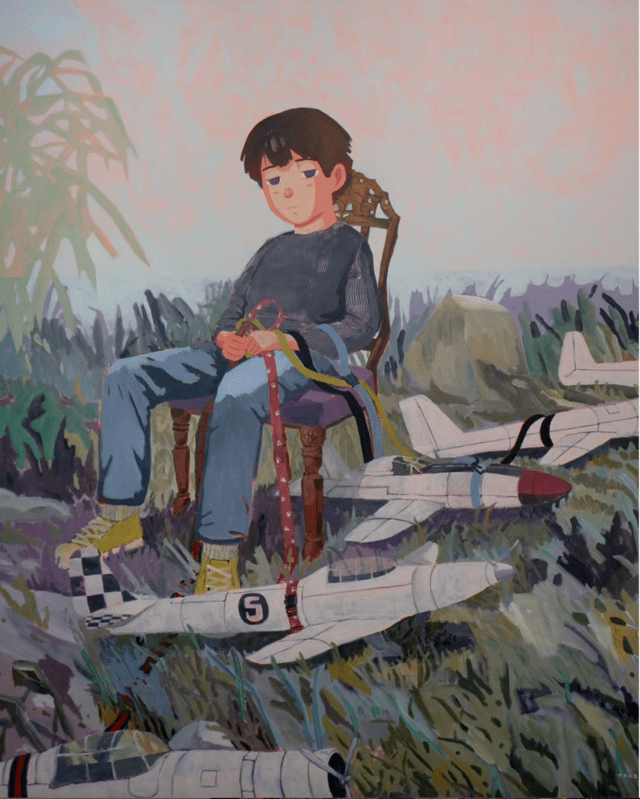
His storytelling ability stems from his background in advertising–he holds a BFA in Advertising and worked as art director at TBWA/SMP. There, he learned the skill of storytelling thru images and “distilling complex ideas in a single frame.” “In a way, the principles of persuasion that guided my advertising work has helped me a lot to better communicate the different narratives I come up with,” he shares.
As one studies TRNZ’s pieces, it’s not difficult to notice an underlying sense of tension or anxiousness in his portraits of innocence. His subjects are most often depicted with a grave or solemn expression. TRNZ admits that anxiety is a constant in his creative process, sometimes fueling his work, other times hindering it. “I often like to play around with ideas that make you feel like you’re not in complete bliss nor sadness,” he shares. “I like it to be dancing around in the middle of those emotions.” (Mica Magsanoc)
Gab Hulleza
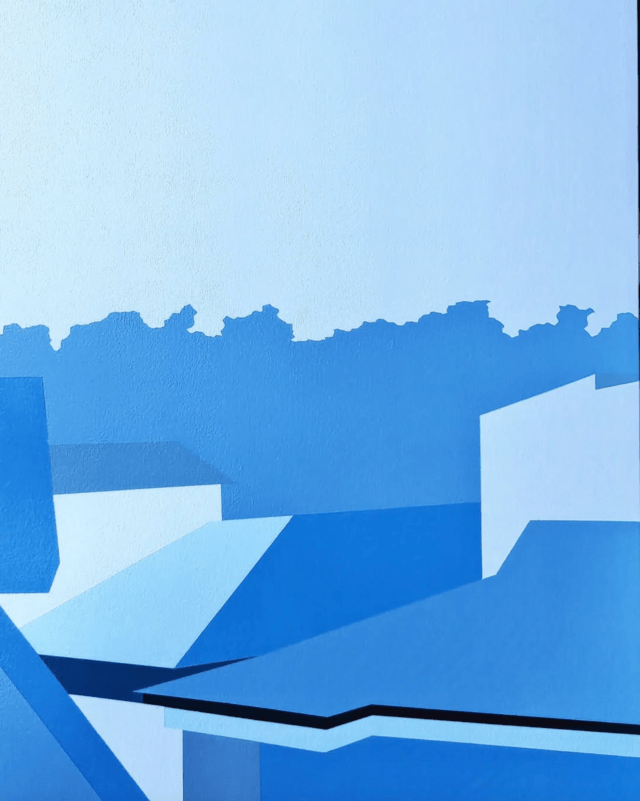
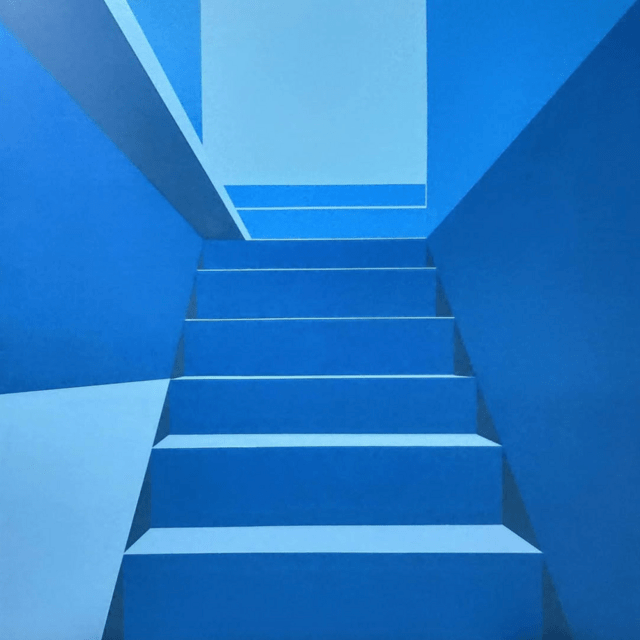
Gab Hulleza paints idealized versions of urban landscapes—the chaos all but removed, the noise muted, leaving only a distilled world of lines and angles charged with color and energy. But beneath the clean lines and semblance of order, Gab says, is an invitation for the viewer to project their own narratives to the landscape, and a quiet protest.
“The clean lines and orderly compositions contrast with the reality of chaotic urban sprawl, poor infrastructure, and social neglect,” Gab tells Spot. “My work isn’t escapism; it’s a mirror held up to what’s missing—a call to reimagine our spaces with intention.”
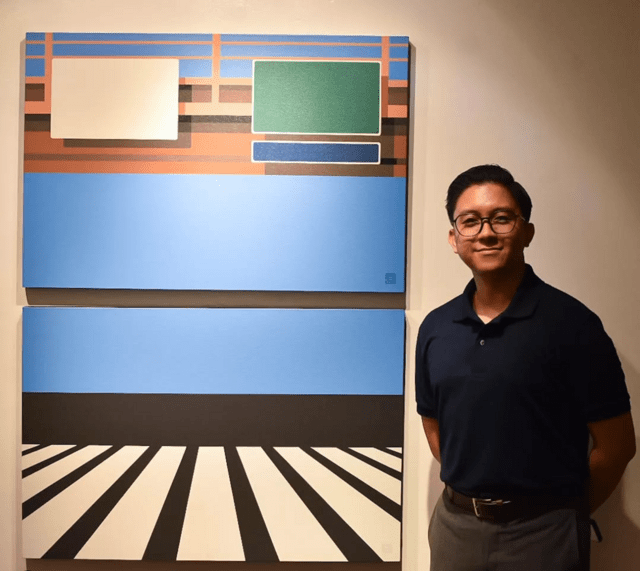
Gab’s idealized cities could also be a longing for the serenity of Marinduque where he spent his younger years. “Growing up in Marinduque gifted me with an intimacy for stillness—horizons unbroken by skyscrapers, nights lit by fireflies.” The now 27-year-old credits his decision to pursue the visual arts to his grandfather, a drafting professor. “His drafting tools, art books, and meticulous calligraphy lessons were my childhood alphabet. Throughout my grade school days, I vividly remember him guiding me through school projects, captivated by his process and precision.”
But it wasn’t until Gab entered the Fine Arts program at the University of the Philippines in Diliman at the age of 16 that he was able to confirm that art is his true calling. “There, I encountered theories and histories that broadened my understanding of art, as well as contextualized my instincts. Suddenly, the provincial landscapes of Marinduque and Manila’s frenetic energy weren’t just backdrops—they became subjects charged with meaning.”
Gab has been painting professionally for seven years and his works have graced exhibitions and fairs here and abroad. He mounted his first solo show last year at White Walls Gallery, which now officially represents him. He is looking forward to another solo exhibit this year but he’s also excited about collaborations. “Art thrives on exchange, a give and take,” he says, “and I want to work with others who challenge the way we see cities, memory, and liminality.”
Josh Serafin
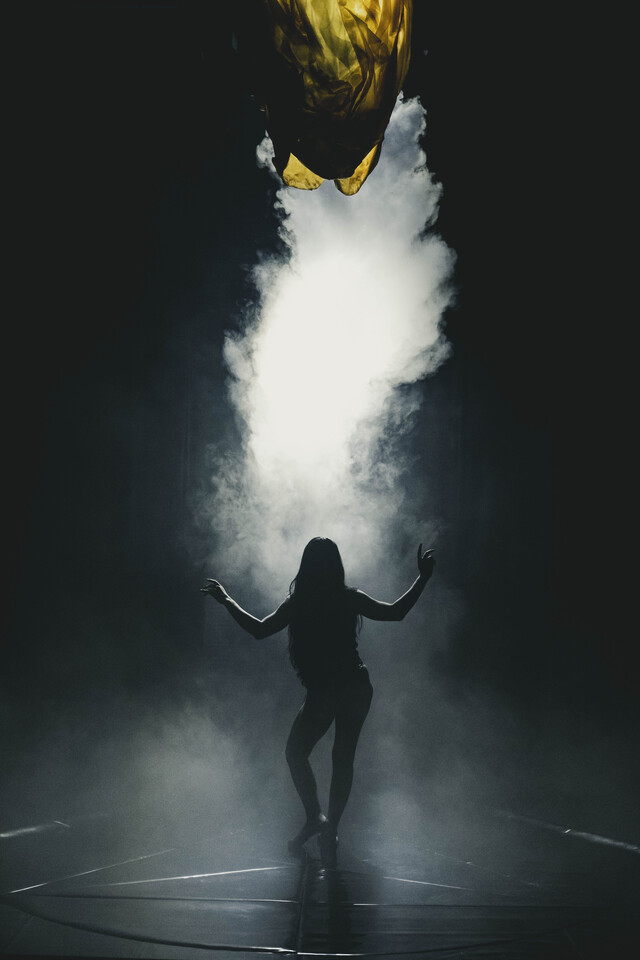
Joshua Serafin’s works are thought-provoking, highly emotional spectacles exploring themes of transmigration and queer politics, combining the disciplines of dance, visual arts, and performance.
Their art has been described as a marriage of “precolonial Indigenous ritual with the steroidally violent beauty of a video game metaverse,”—this after a viewing of their signature piece VOID. Meanwhile, writes the avant garde magazine Coeval, their work is “more than just an expression of movement” but are “ritualistic journeys that confront personal trauma, emotional depths and the complexities of identity…Few artists blur the lines between the personal and universal as powerfully as Joshua.”
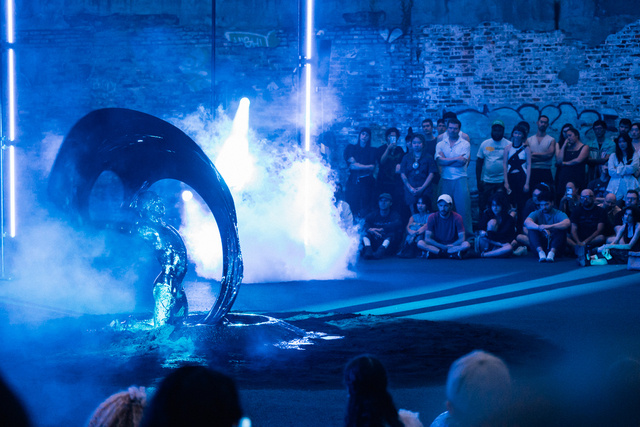
Joshua is a Theater Arts graduate of the Philippine High School for the Arts but their fields of study will only go further, resulting in the multi-disciplinary artist they are now. They told Art Forum: “After training in theater for five years, I studied dance for nearly fifteen. When I graduated with a degree in contemporary dance, I felt that I only knew how to materialize an idea through an embodied state. I needed to stop the body in order to understand other modalities of making; to externalize my process of creation. So I did a master’s in fine arts, to articulate and understand materiality.”
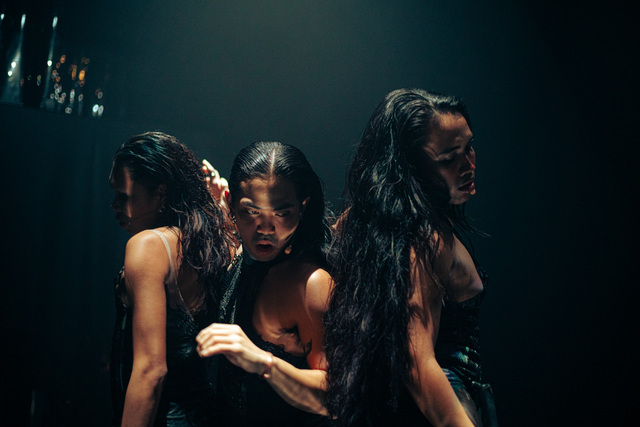
The Philippine-born Serafin, who was part of last year's Forbes Asia List of 30 under 30, is currently based in Brussels and is a house artist of Viernulvuer, the famed art center in Belgium. “But most of the time I’m on the road, combining research, tour performance, and preparing shows in the upcoming year,” they tell Spot. Joshua is currently developing a “new cosmology of work” that hopes to combine all the elements in their practice. “I am very much as well excited in starting a small artist residency program together with my friend Zoe Marden in the Philippines where we invite Filipino artists and share space and practices together in a period of time.”
When asked what they are most looking forward to this year, Joshua says: “Meeting people and understanding and diving / living / with different communities.”
Is Jumalon
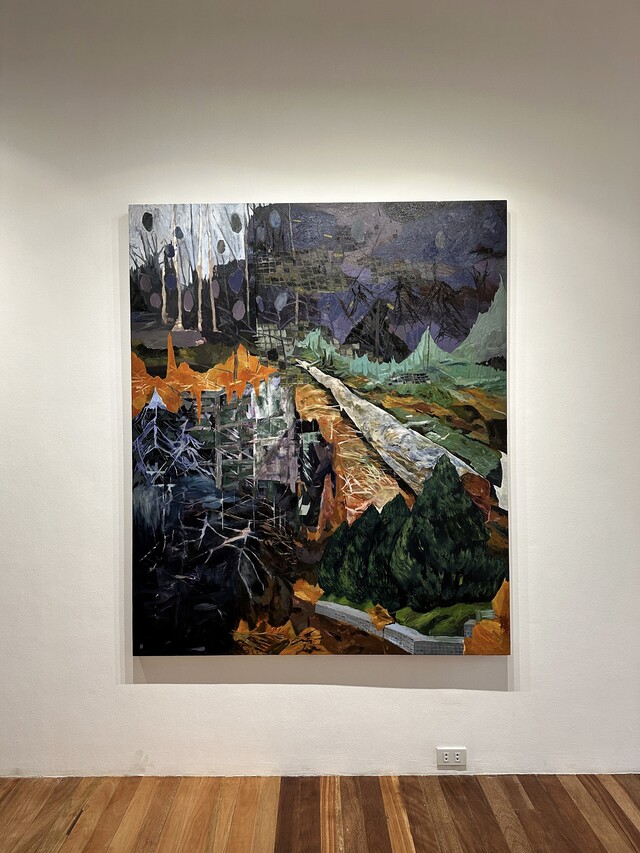
Is Jumalon comes from a family of artists in Zamboanga, their house a hangout for the city’s creative souls. Her folks would sometimes even invite artists over just to make art. But Is herself, the youngest of four children (acclaimed portraitist Winner Jumalon among them), never took art seriously. Until she was encouraged to take the talent exam in UP Fine Arts in Diliman—just for the heck of it—and surprisingly passed. “I think that’s the only time I took art seriously. I enjoyed it.”
Fast forward to today and Is is among the most admired young Filipino artists. She’s done solo shows at prestigious spaces like Blanc, Underground, and most recently West Gallery—where she just closed an exhibit called Here, Not Here. Having lived in different places in her young life —Zamboanga, Dumaguete, and Manila—Is knows the significance of connecting to her environment. Her more recent works feature exteriors of homes that seem to have sprouted in the middle of nowhere, some of them overwhelmed by nature untended and unmanicured. While it may sound like she’s trying to evoke a sense of desolation, her colors and the overall exuberance of her images say something else—she’s inventing a new landscape.
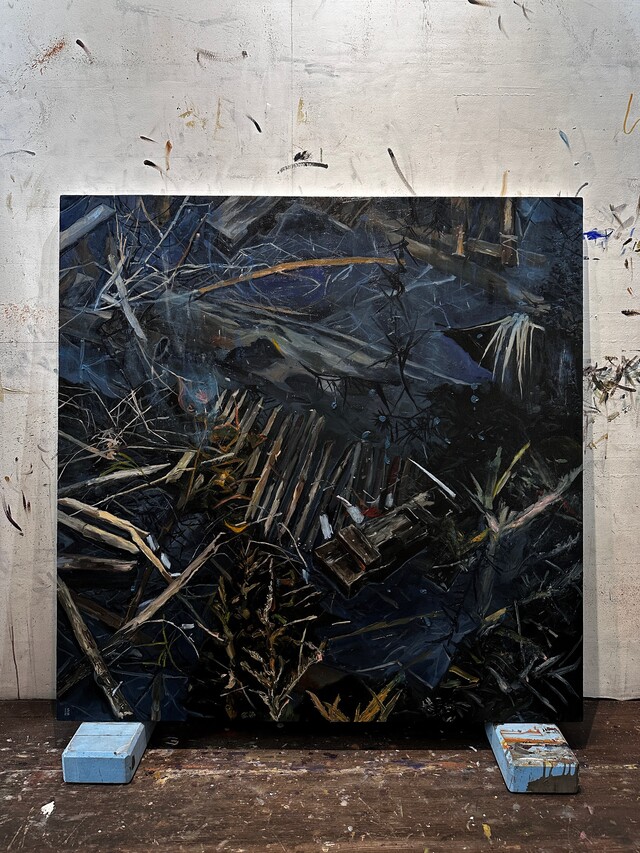
“As an artist, I find joy in the process of piecing together different images of the natural and urban landscapes to create entirely new worlds,” says Is. “My work explores the idea of reimagining familiar scenes by combining fragments from nature like shapes, colors, textures, or atmospheres. Through this process, I aim to challenge the viewer’s perception of nature, inviting them to see the world from a different perspective.”
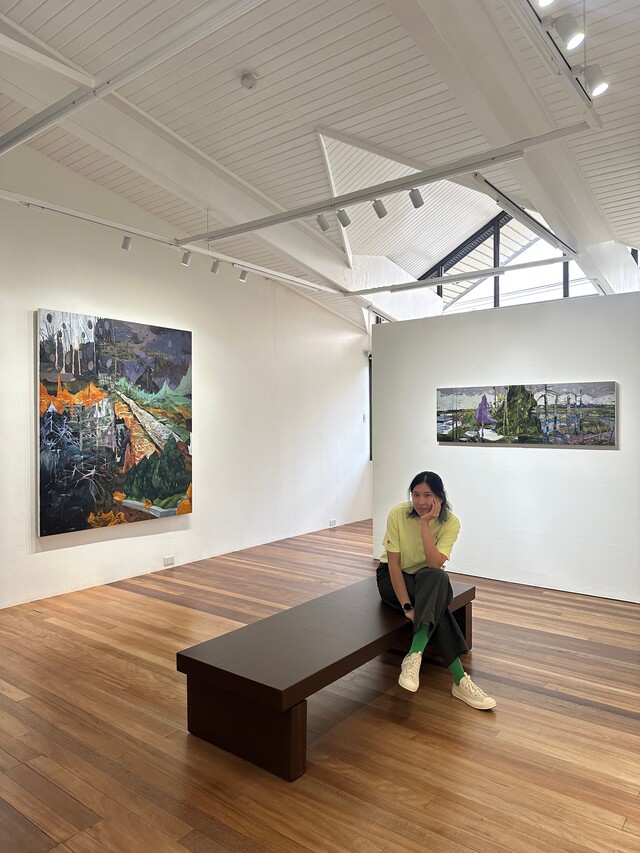
While she admits her entire family is a great influence in her artmaking, Is singles out her father, the painter Edwin “Duwende” Jumalon, as having the greatest impact in her life. “I think it’s his character and integrity towards life and art that I truly admire. Growing up surrounded by his expressions, I learned to see the world through an artistic lens and to be aware of anything that holds potential for creativity. His influence has been a constant source of inspiration, reminding me that art is not just a practice, but a way of life.”
Babylyn Geroche Fajilagutan
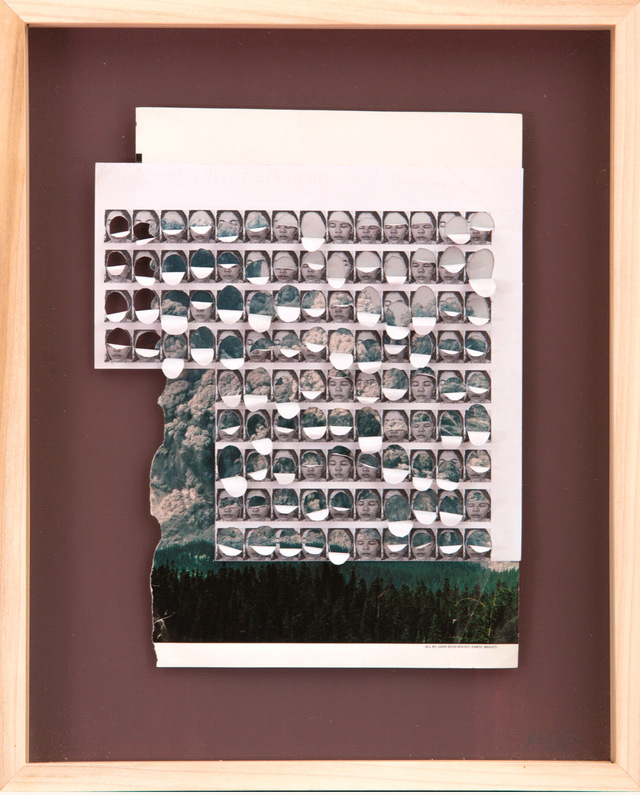
It can feel intrusive looking at the mixed media works of Babylyn Fajilagutan, what with each piece having that strong personal journal vibe, inviting audiences to come closer to better catch the whispers, the secrets, the artist’s most private musings. The works of this UP Fine Arts graduate usually involve objects from her collection of ephemera: threads, textiles, pages from her own journal, even pictures of her younger self. There’s almost a fixation towards introspection, but the works’ childlike innocence and DIY charm provide the non-threatening codes inviting the viewer to indulge his or her voyeuristic nature.
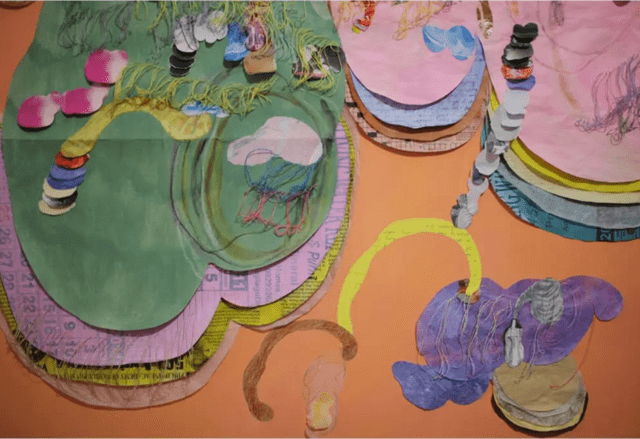
Color is important to Babylyn. It always comes first, she wrote recently on her Instagram, describing a piece of hers shown at the last Art Fair Philippines via Kaida Contemporary. “Nagsisimula ako lagi sa pagpili ng kulay. I treat the process as pagkilala doon sa kulay at kung paano ko siya gagawing visual problem,” she says in a video about a painting for an earlier Art Fair edition. The paper and threads she adds are there to represent the formal elements of lines and texture. “The repetitive slices, cuts, and puncturing stitches are a metaphor for self-examination and reconfiguration,” she says, talking about her works for Marahuyo Projects. They all come together in the end, proving humble objects can say big things, and the very personal always has a way of being universally recognizable and enchanting.
Celine Lee
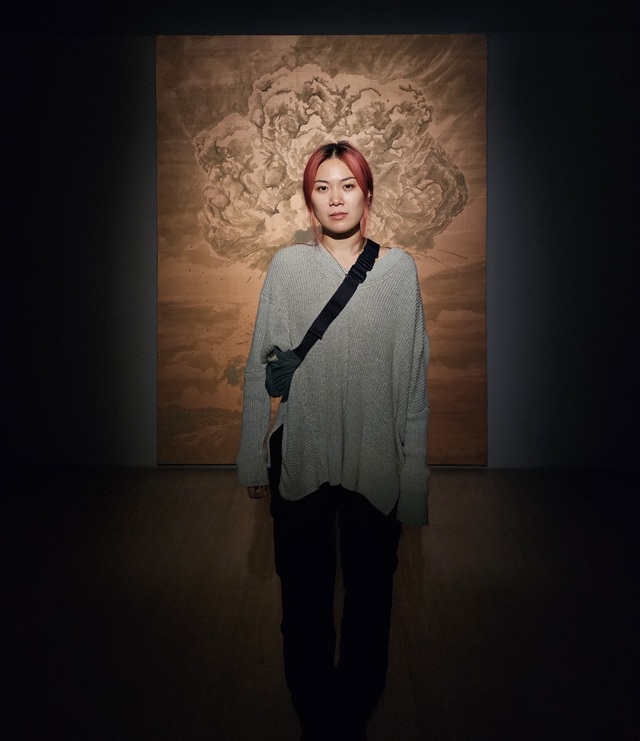
Celine Lee’s path to becoming an artist was unexpected. Initially waitlisted for an Architecture program at the University of Santo Tomas, she instead enrolled as a Painting major. She recalls feeling “dismayed” by the shift, but ultimately embraced it. Today, Lee has had eight solo exhibitions, with The Length and Breadth of Depth and The Brightest Part both shortlisted for the Ateneo Art Awards Fernando Zobel Prizes for Visual Art in 2021 and 2023, respectively.
Her creative process is deeply rooted in inquiry and experimentation. She describes it as “following the structure of the scientific method, but without the conclusion… an endless loop of questioning and experimenting.” This approach is evident in her geometric explorations and her fascination with the intersection of art, science, and mathematics—fields not typically associated with one another, but which she sees as inherently connected.
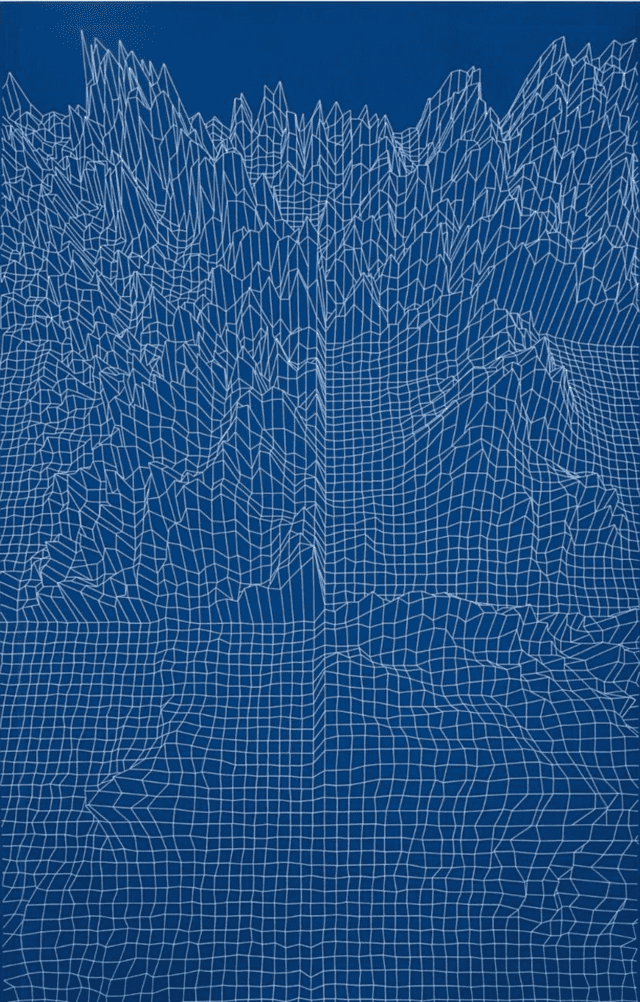
In a 2019 solo exhibition held at MO_Space titled A Surface, Celine used aluminum sheets etched with Philippine topography, transferring the images on abaca and rice paper which were then compounded together. These materials were chosen to highlight the long-standing territorial dispute between the Philippines and China, with abaca fiber and rice paper being abundant resources from each respective country. “The exhibition is an attempt at pointing out the awareness of space, or lack thereof,” she shared in an interview with Cartellino.
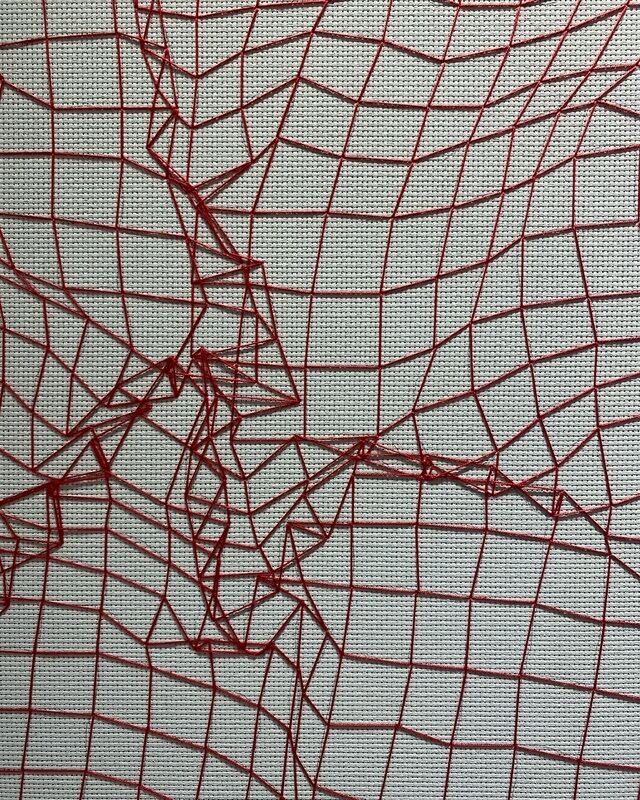
Her 2024 exhibit at ALT Philippines further explored geometry and topography. Using the 3D software Blender, she rendered digital topographic images which she then hand-stitched onto Aida cloth. This series has become one of the artist's most recognized works, with various pieces displayed in Art SG, Xavier Art Fest, and more.
“I started using Aida cloth (back in 2017) because of its grid-like pattern,” Celine tells Spot. “I found it interesting how in cross-stitching, you are given a pattern with legends to follow in order to create a certain image/picture. So to me, the Aida cloth functioned as this hypothetical map and going through each hole of its weave is like navigating coordinates."
In 2022, Celine returned to MO_Space, this time using mirrors as her primary medium. Positioned throughout the gallery, the mirrors reflected light at various angles, creating shifting, fragmented shadows that changed with the viewer’s movements.
In her 2023 exhibit Free Space at Art Informal, she presented a giant green cube composed of 540 lenticular prints. Captured on a smartphone between 2019 and 2023, the images depicted everyday moments—half-face selfies, pedestrian signs, snapshots of pets, doodles on hands. Writer James Tana described the exhibition as “a conscious act of offloading personal images in limbo, as Lee attempts to make space for something else.”
Celine’s practice is defined by her refusal to be confined to a single material. From printmaking to found objects, her work is constantly evolving. “Once I stick to one, it’s as if I’m being boxed in," she says. "I feel like in playing with different materials, it's where I get to play with my creativity.”
As she prepares for her ninth solo exhibition, Lee’s focus is on revisiting past works and series—continuing to refine and expand upon the ideas that have shaped her artistic journey. (Mica Magsanoc)
Catalina Africa
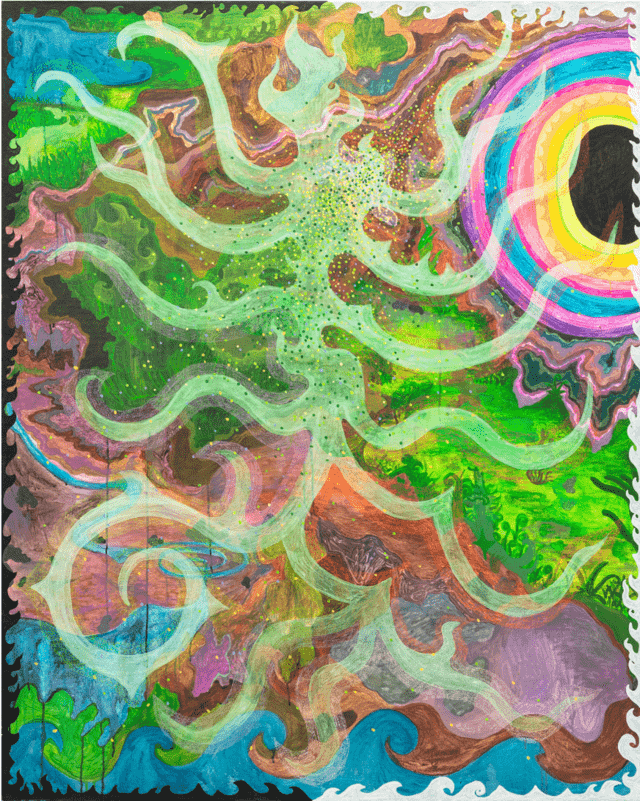
Catalina Africa’s artistic practice is deeply rooted in her relationship with nature, shaped by her move from Manila to Baler in 2015. Immersing herself in the rhythms of the land, she developed a more intuitive approach to art, where painting became an extension of her connection to the environment. Her work explores the fluid boundaries between self, community, and landscape, treating nature as both subject and collaborator.
Africa has participated in prestigious artist residencies— at 1335 Mabini, the Skowhegan School of Painting and Sculpture in Maine, and the Baler Artist Village. In 2024, she was recognized as one of the CCP’s 13 Artist Awardees. Represented by Silverlens, she was also featured at Art Basel Hong Kong 2025, solidifying her presence on the international art scene.
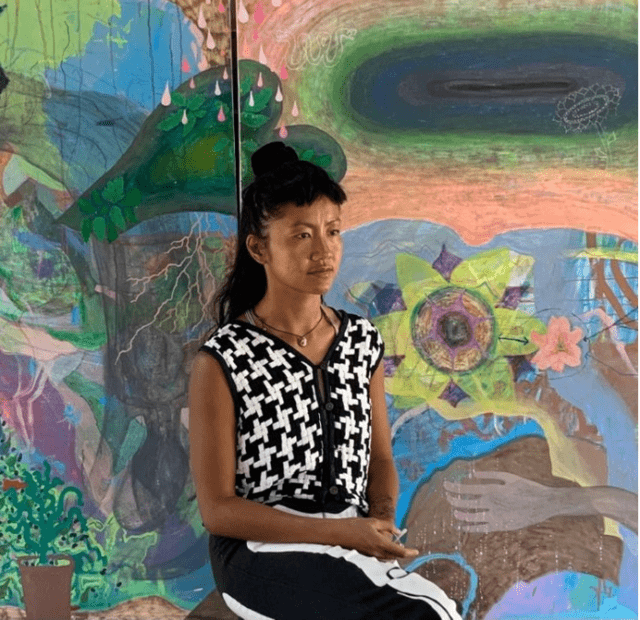
In one of her recent exhibits, Spirit Ecologies at West Gallery, she reflected on her evolving perspective on nature. In the exhibit write-up, Africa shares, “...my community is my developed relationship with the land. The plant beings, the elements are my community.” Her works were dominated by green and purple hues, with drawings of vines, leaves, and flames extending beyond the canvas and onto the walls—portraying the environment as a living, breathing force.
The centerpiece of Spirit Ecologies was a depiction of a bitaog tree from her home, bursting with color and surrounded by swirls of violet and yellow. This sense of interconnectedness between the land and its energy is a recurring theme in Africa’s work. “They say that nature has its own language,” Africa reflects in an interview with Cartellino. “I feel I am studying what that means for me.”
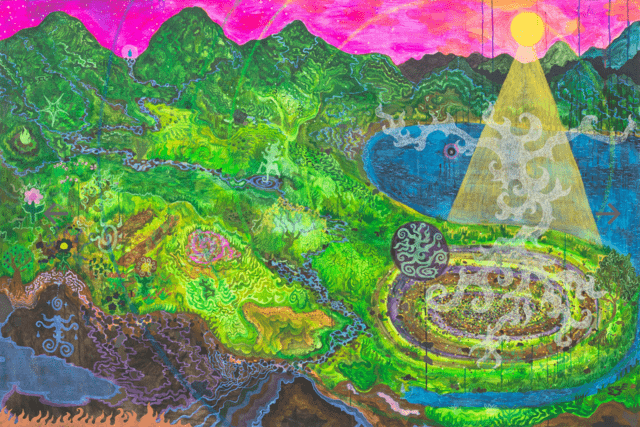
Currently, Africa is presenting Earth Body Bukid at Silverlens New York, further exploring her relationship with the landscape of Baler. Her paintings reflect the dynamic, ever-changing nature of the environment, portraying land, water, and plant life as animated, interconnected forces. The exhibit features three new works: a series of “plant portraits” alongside a “map.” For Africa, painting is not just an artistic expression but the culmination of a holistic process—one that involves soil restoration, composting, growing food, and creating herbal medicines. “The energy of my work comes from the Baler landscape,” she shared to Cartellino. “I am a conduit to translate the language of nature.” (Mica Magsanoc)
Comments